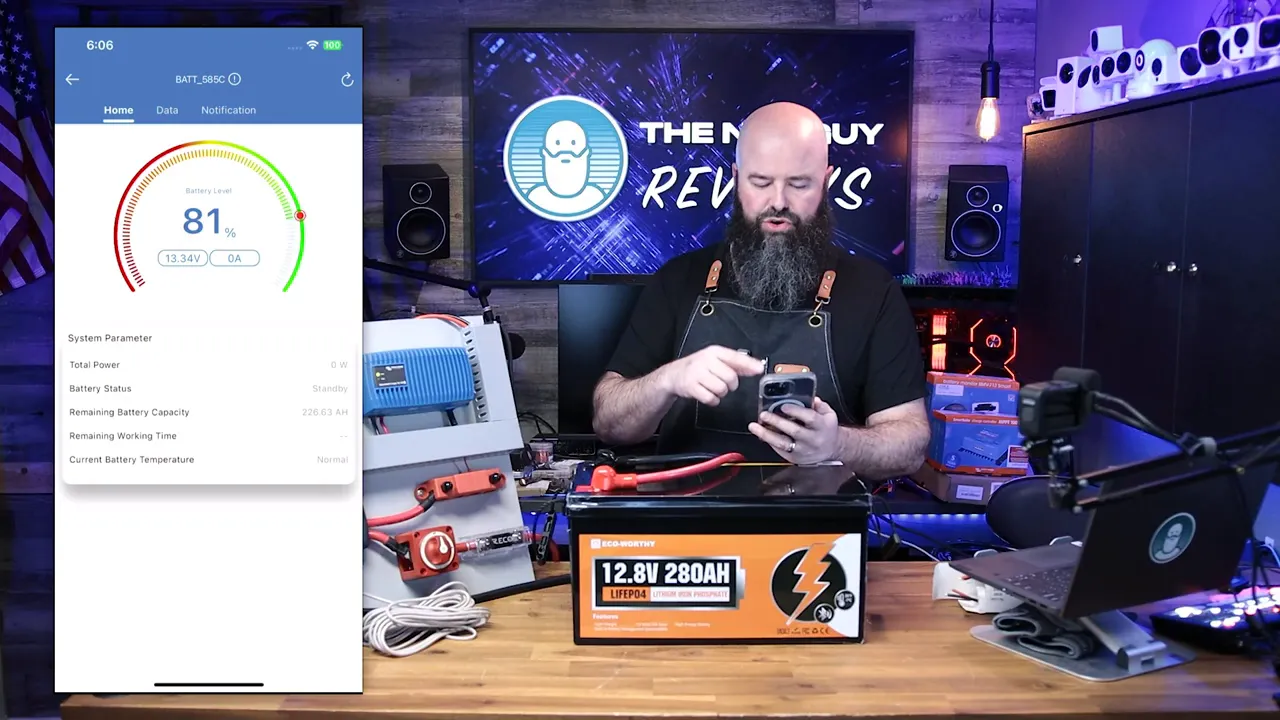
Hey, it’s Jon — The Net Guy. I recently upgraded to the Eco-Worthy 280AH Lithium Iron Phosphate (LiFePO4) battery and wanted to walk you through what makes this big battery such a practical, modern replacement for the old lead-acid and golf-cart-style deep cycle batteries most of us grew up with. In short: more usable capacity, a lighter package for the same energy, Bluetooth monitoring, a built-in BMS, low-temperature protections and the kind of runtime that makes being off-grid or out on the water way more enjoyable.
Considering this item? Using my Amazon affiliate link: Amazon Store earns me a small commission. Thanks!
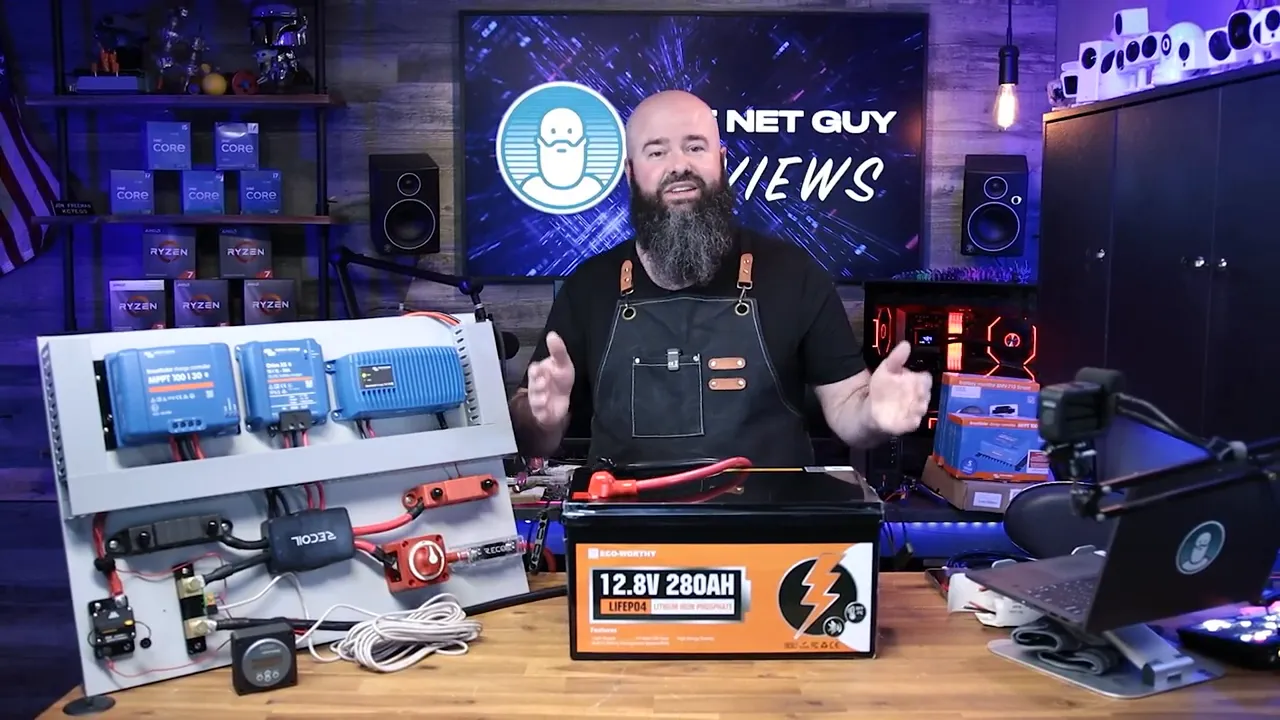
Why I picked a LiFePO4 battery (and why you should consider one)
If you’ve been running lead-acid or “golf cart” deep-cycle batteries, you already know the tradeoffs: heavy weight, limited deep discharge life, sulfation risk if you frequently let them sit partially charged, and a shorter overall lifecycle. LiFePO4 chemistry changes that equation. These batteries are designed to deliver higher nominal voltages, have lower internal resistance, and tolerate much deeper discharge cycles without the same capacity degradation.
Specifically, LiFePO4 batteries:
- Have higher resting and charging voltages (so more usable energy per cell stack).
- Have much lower internal resistance, which improves efficiency and supports higher current draws without heating up.
- Last far longer: many LiFePO4 cells are rated for thousands of cycles — often 6,000 to 10,000 cycles or more — with only modest capacity fade. For context, lead-acid batteries typically start to lose meaningful capacity after a few hundred cycles.
From a practical perspective, that means fewer battery swaps, less weight for the same stored energy, and a more predictable system when you’re relying on batteries for critical devices (for me, that’s things like Starlink on the boat, fridges, pumps, and head units).
Understanding amp-hours and why the math matters
One of the most common questions I get is “what does 280AH actually mean?” It’s not mystical — it’s math. Amp-hours (Ah) describe how many amps a battery can deliver for an hour at a particular nominal voltage. For most 12V LiFePO4 batteries the nominal voltage is 12.8V. To convert to usable watt-hours (which is often easier to reason with when you compare loads), multiply the amp-hours by the nominal voltage.
Example math (simple and useful):
- 100 Ah battery at 12.8V = 12.8 × 100 = 1,280 watt-hours (Wh).
- 280 Ah battery at 12.8V = 12.8 × 280 = 3,584 watt-hours (Wh).
That 3,584 Wh number is what you’re actually able to spend powering things. Let’s look at a couple of examples I tested during setup so you can see how that translates into run-time:
- Mini fridge running at ~50W: 1,280Wh / 50W = ~25 hours on a 100Ah battery (as a baseline). On the 280Ah Eco-Worthy, multiply runtime roughly by 2.8 — so more than two days.
- Starlink dish at ~24W: 1,280Wh / 24W ≈ 53 hours on a 100Ah battery. On the 280Ah Eco-Worthy you’re looking at ~148 hours (that’s over six days) under ideal conditions.
Those are the kinds of real-world numbers that change how you plan trips or back-up power. Instead of rationing device use, you gain real flexibility. Add in some solar or occasional alternator input from your van, truck, boat, RV or travel trailer to offset your losses and you can last even longer on battery.
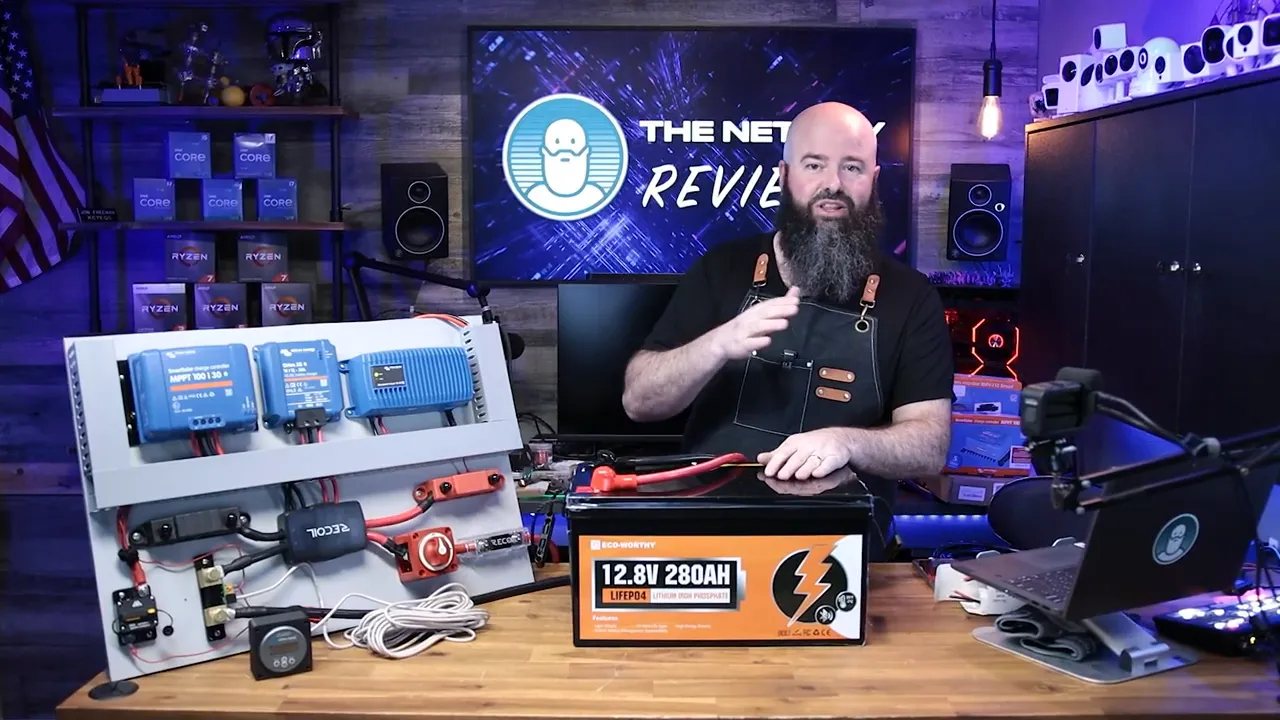
Eco-Worthy 280AH: capacity, weight and how it compares to old-school batteries
When I compare the Eco-Worthy 280Ah to traditional batteries, two things stand out: capacity-per-weight and total usable energy. My older lead-acid deep-cycle batteries (the ~80Ah/100Ah style) weigh a lot — in my case the 80-ish Ah lead-acid units were around 65 lbs each. Compare that to LiFePO4: smaller 100Ah LiFePO4 units often weigh only ~20 lbs.
The Eco-Worthy 280Ah itself weighs in around 62 lbs. That’s a heavier single unit relative to a small 100Ah LiFePO4, but remember: it replaces nearly three 100Ah lead-acid batteries and provides far more usable capacity for roughly 1/3 the weight compared to lead-acid equivalents to reach the same Wh. In plain terms: much more energy for a lot less weight when you do a system-level comparison.
- Lead-acid: bulky, heavy, often need multiple units to equal the 280Ah worth of storage.
- Eco-Worthy 280Ah LiFePO4: ~62 lbs, compact for the amount of energy packed into it.
Built-in BMS and Bluetooth monitoring — why those matter
One of the features I really like about this Eco-Worthy pack is the built-in Battery Management System (BMS) with Bluetooth. In the early days of DIY Li-ion packs you had to assemble cells and add external BMS modules, manage balancing manually, and that always added complexity and risk. This Eco-Worthy unit has an internal BMS that takes care of:
- Cell balancing (so no one cell gets overcharged relative to the others).
- Over-voltage and under-voltage protection.
- Over-current protection and short-circuit protection.
- Temperature monitoring and a low-temperature cut-off for charging.
On top of that, the Bluetooth interface makes monitoring the pack painless. With the Eco-Worthy app (or integrated displays using compatible inverters/chargers that read the pack), you can see state-of-charge, current in/out, time remaining estimates, individual cell voltages and receive warnings about conditions that need attention. This kind of diagnostics is a huge step forward compared to legacy batteries that gave you zero insight unless you were adding external meters.
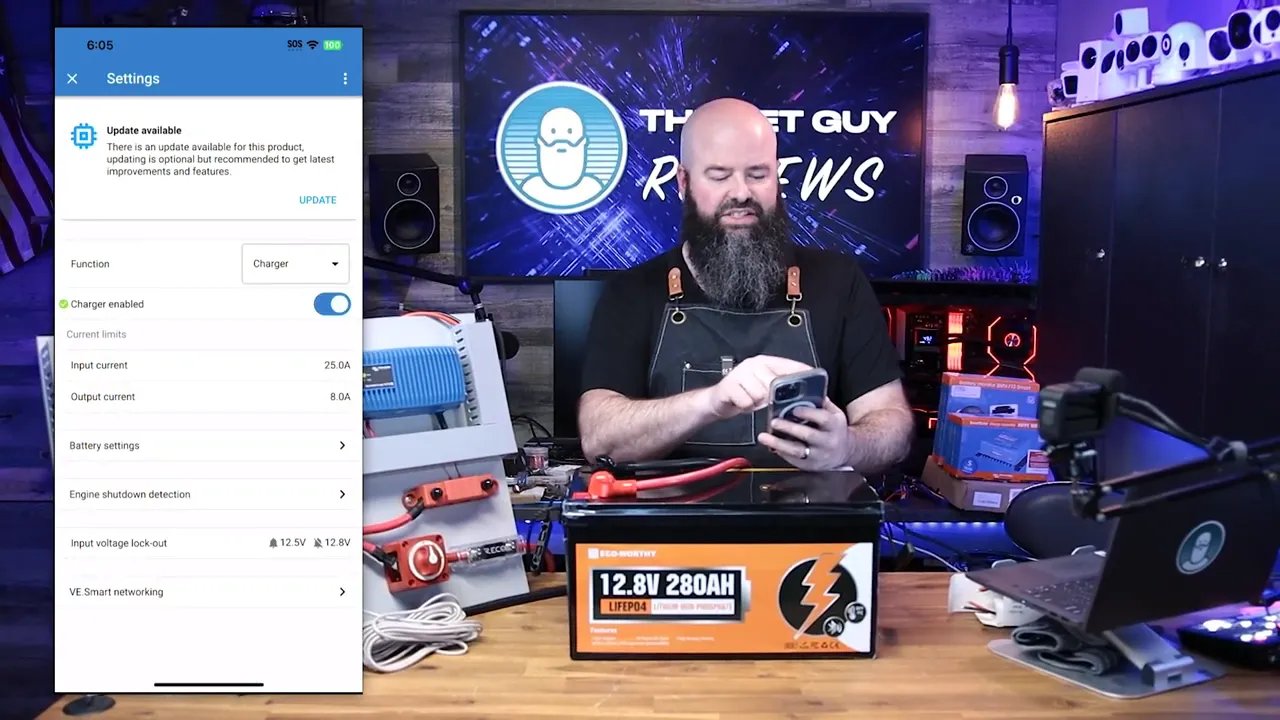
Charging behavior, Victron Connect demo and charger considerations
I paired the battery with my Victron setup to show how charging looks in practice. A couple of practical notes from the testing:
- LiFePO4 batteries rest at a higher voltage than lead-acid, and they accept charge differently — typically a higher charge voltage and a different absorption profile.
- Low internal resistance means chargers must be LiFePO4-aware. If you use an old lead-acid charger profile, you risk poor charging efficiency and potentially tripping protections.
- In my test, I enabled a charger to feed at 8A just to demonstrate behavior. The Eco-Worthy unit will report charging current, state-of-charge, and switch through charge stages (bulk, absorption, etc.).
When I turned on the charger via Victron Connect, the software read inputs, current and enabled charging. One thing to note: the battery sometimes reported “absorption charge” or even a state that looked like it was full, so it didn’t always accept the full configured amperage immediately. That’s normal behavior — the BMS manages cell balancing and can restrict charge if it thinks cells are near full. Equally, when you pull a load the system reports current draw live and will show time-remaining estimates, which is incredibly helpful when planning energy usage on trips.
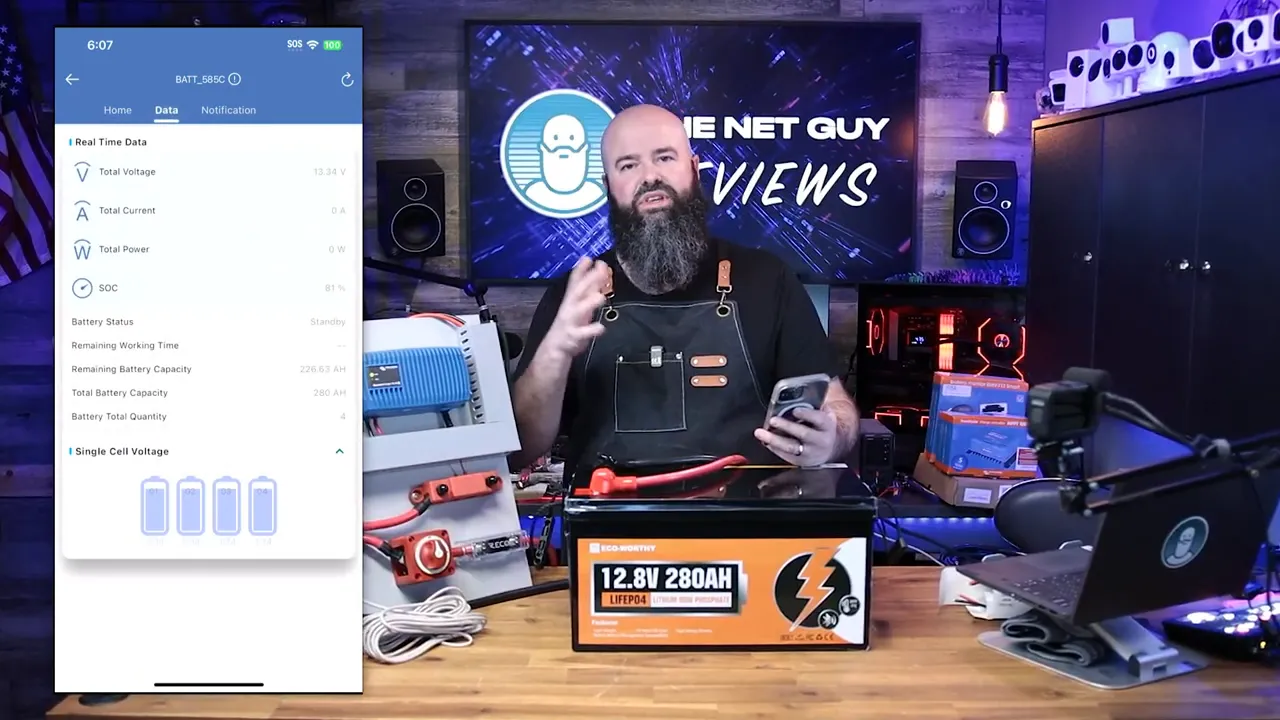
Temperature limits and the low-temperature cut-off
One of the features that surprised me in a good way is the Eco-Worthy BMS low-temperature charging cut-off. Many Li-ion and LiFePO4 systems warn against charging below freezing because charging at very low temps can plate lithium and damage the chemistry. This Eco-Worthy has a built-in temperature cutoff that prevents charging below about 19°F. In practice that means:
- You can discharge the battery at sub-freezing temps (draw power) without this safety cutoff stopping you.
- But you should not attempt to charge below the specified cutoff (the BMS will block charging to protect the cells).
- This is useful for people who keep systems on boats, in cold garages, or run trolling-motor packs that might sit in cold conditions.
For boat owners or those who use batteries for trolling motors (36V setups are common using three 12V batteries in series), it’s especially important to have a low-temp cutoff. If your pack is going to be used in colder climates or stored in a place that sees freezing temps, confirm that the BMS supports the operational range you need.
Longevity: cycles, capacity fade and real-world expectations
LiFePO4 chemistry is known for long cycle life. Eco-Worthy and similar reputable manufacturers often rate cells for thousands of cycles. It’s common to see 6,000–10,000 cycles quoted on many LiFePO4 products. What does that mean in practice?
- Cycle ratings are often defined as charge-discharge cycles down to a particular depth of discharge (DoD) and with a specified % capacity retention at the end of the rating (for example “80% capacity after X cycles”).
- In everyday terms: if you cycle a LiFePO4 pack once per day, a 6,000-cycle rating corresponds to roughly 16 years of daily cycling. That’s a game changer for boaters or mobile users who formerly replaced batteries every handful of years.
- LiFePO4 does not suffer from sulfation the way lead-acid does, and the BMS prevents many of the conditions that cause premature battery failure.
All of that said: real-world lifespan still depends on how you use the battery. Extreme temperatures, chronic over-current events, or improper charging configurations will shorten its useful life. But with sensible setup and a compatible charger/inverter, LiFePO4 will give you longer service life and more stable performance over time.
Practical installation tips and things to watch for
If you’re installing a large LiFePO4 battery like the Eco-Worthy 280Ah, here are some tips from my experience to make the process smooth and reliable:
- Check compatibility with your inverter/charger and set the charging profile to LiFePO4. If your system is Victron or another modern brand, they typically have a LiFePO4 preset — use it.
- Mount and secure the battery in a ventilated, dry location. While LiFePO4 doesn’t vent like lead-acid, safe mounting still matters for physical protection and wire routing.
- Use appropriate cables and fuses sized for the potential charge/discharge currents. LiFePO4 can supply high currents; undersized wiring is a safety issue.
- Wire any series/parallel battery banks exactly as recommended by the manufacturer. Uneven wiring can cause imbalance and stress the BMS.
- Monitor the battery via Bluetooth during the first few charge/discharge cycles to make sure the BMS and the rest of your system behave as expected.
Use cases where the Eco-Worthy 280Ah really shines
After setting this battery up and testing a few loads, I found a number of excellent use cases where this pack is ideal:
- Boats and marine systems: long runtimes for fridges, navigation electronics and comms (Starlink included).
- RV and van life: compact energy to power appliances, fans, pumps and charging devices without the weight penalty.
- Home backup: enough capacity to run key loads for many hours during a grid outage.
- Mobile internet setups: Starlink and similar devices consume modest wattage relative to the energy stored here, giving days of continuous connectivity depending on how many other loads you attach.
- Trolling motor banks: combine multiple batteries in series for 24/36V systems — just be sure the BMS low-temperature behavior and series wiring match manufacturer guidance.
Common questions I get asked (and my answers)
Q: Can I just swap this into my existing lead-acid setup?
A: Maybe. Physically, yes if the terminals match and your inverter/charger supports LiFePO4 charge profiles. However, check charging voltages and make sure any alternator charging, solar charge controller or shore power charger recognizes LiFePO4. If not, you can damage the BMS or the battery. You may need to use a DC-to-DC charger to switch.
Q: Can I parallel multiple Eco-Worthy 280Ah batteries?
A: Yes — but follow the manufacturer’s wiring and BMS recommendations. When paralleling batteries, balance the wires so one pack doesn’t take a disproportionate amount of current during charge or discharge. Many users parallel identical, same-age packs for larger capacity systems.
Q: What about fast-charging?
A: LiFePO4 can accept higher charge currents than lead-acid due to lower internal resistance, but you must size the charger and cables appropriately and confirm the BMS allows the charge rate you plan to use. Fast charging can be safe when done properly — but the BMS exists to protect the cells and will limit currents if something is out of spec.
Pros and cons (quick summary)
- Pros: High usable capacity, long cycle life, lighter weight for capacity, built-in BMS, Bluetooth monitoring, temperature protection, low self-discharge.
- Cons: Higher upfront cost than lead-acid, requires LiFePO4-compatible chargers and sometimes attention to wiring when paralleling or creating series banks.
Final thoughts and recommendation
The Eco-Worthy 280Ah LiFePO4 battery is a great option for anyone who needs a lot of usable energy in a compact form factor and wants modern BMS features like Bluetooth monitoring and temperature protections. For liveaboards, weekend boaters, RVers, and anyone setting up a reliable backup or off-grid system, this battery removes many of the traditional headaches like weight, sulfation, and short cycle life.
My personal experience: it’s a straightforward setup, the monitoring features are genuinely helpful, the runtime numbers speak for themselves, and the weight-to-energy ratio makes it an easy upgrade from older lead-acid systems. The temperature cutoff at ~19°F for charging is also a thoughtful safety measure that I appreciate as someone who takes gear on the water and outdoors in varying climates.
Considering this item? Using my Amazon affiliate link earns me a small commission. Thanks!
If you want to see the step-by-step install, the Victron pairing and the runtime demos, I cover all of that in detail on my channel. And while you’re at it, please consider subscribing — I post more home, tech and auto gear reviews that I think you’ll find useful.
Subscribe to my YouTube channel: https://youtube.com/thenetguy
